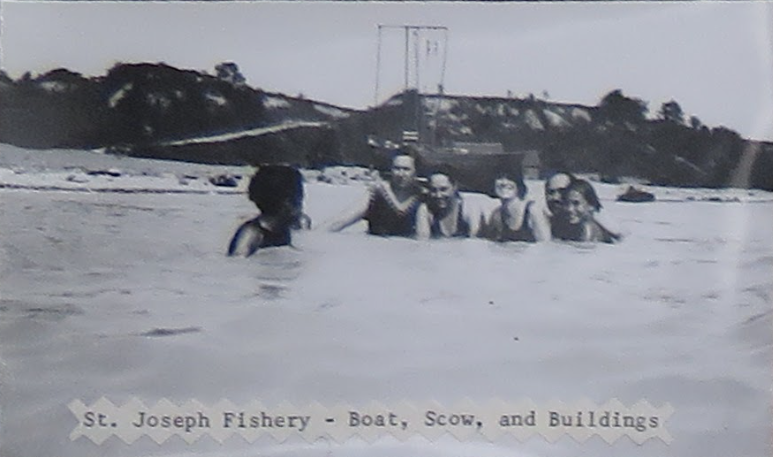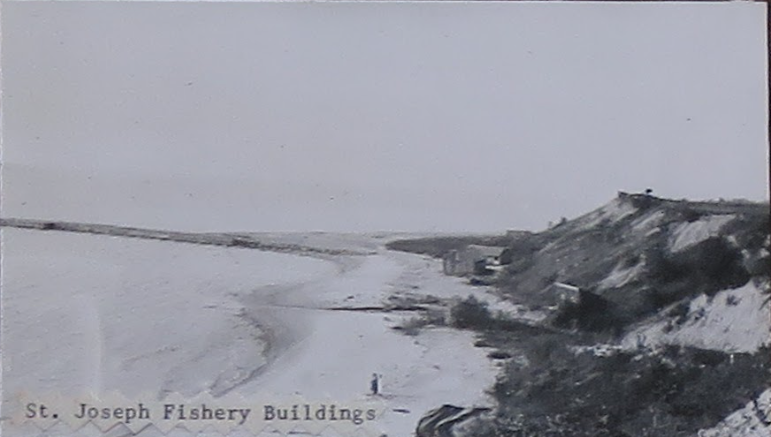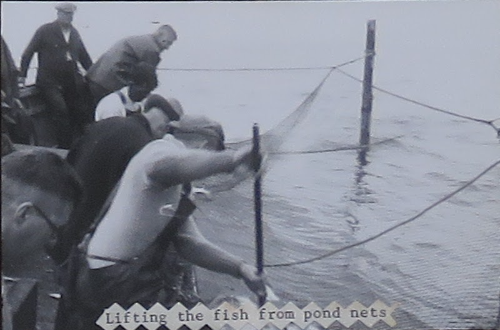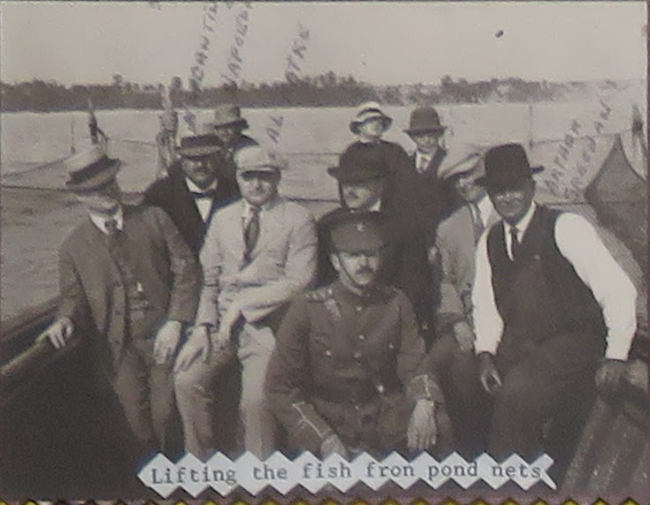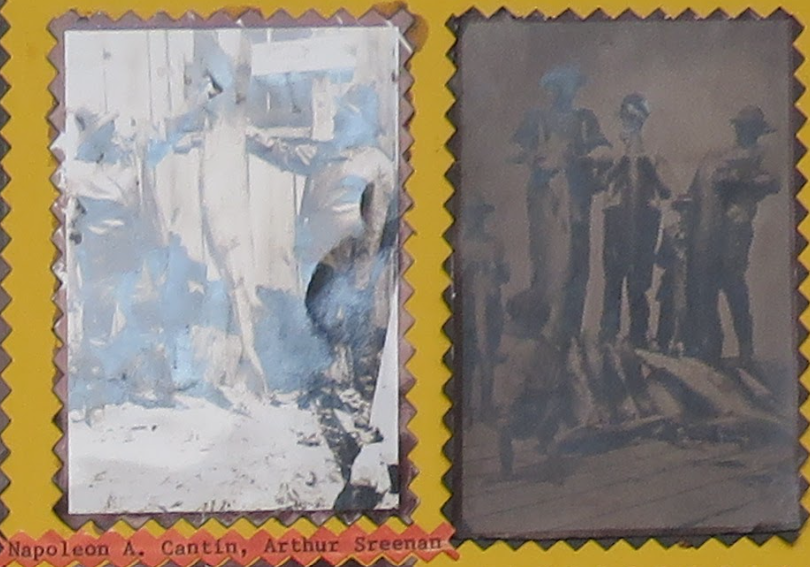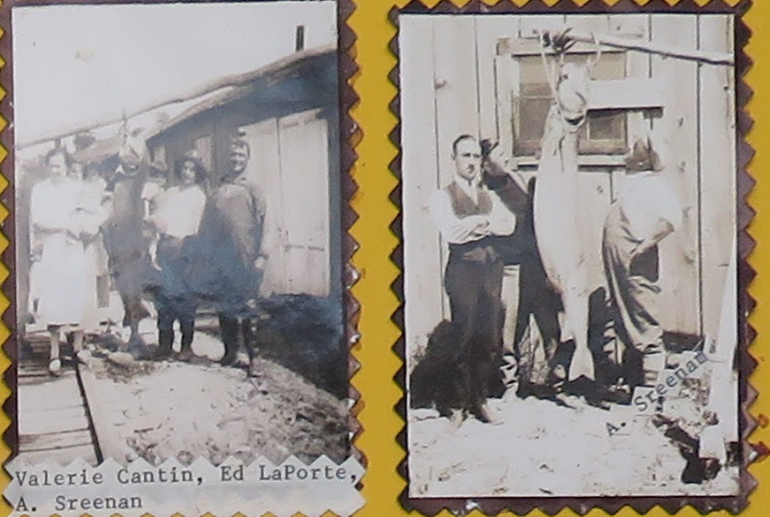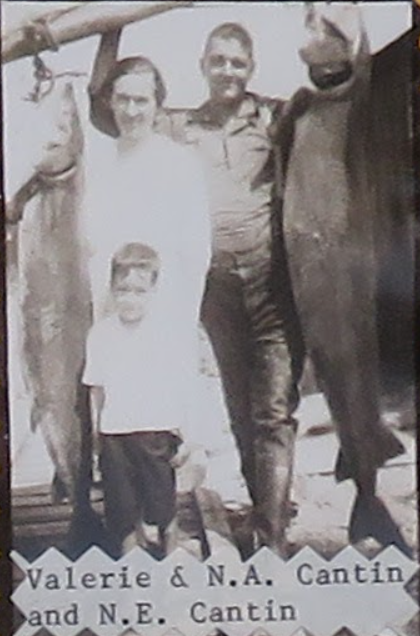
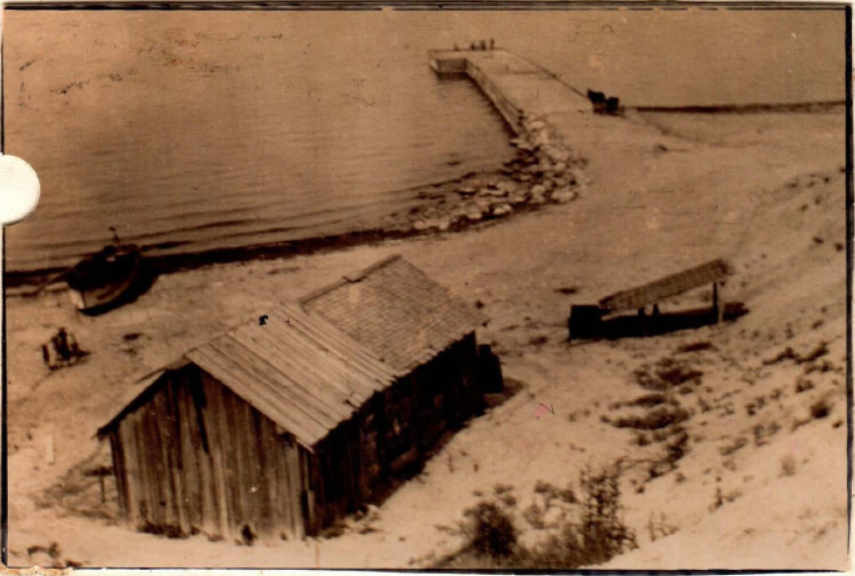
The first fisheries in Hay Township was started in St. Joseph in the early 1900’s with Pound Nets owned and operated by Edward and George Brisson, sons of John Brisson and Armeline Ducharme.
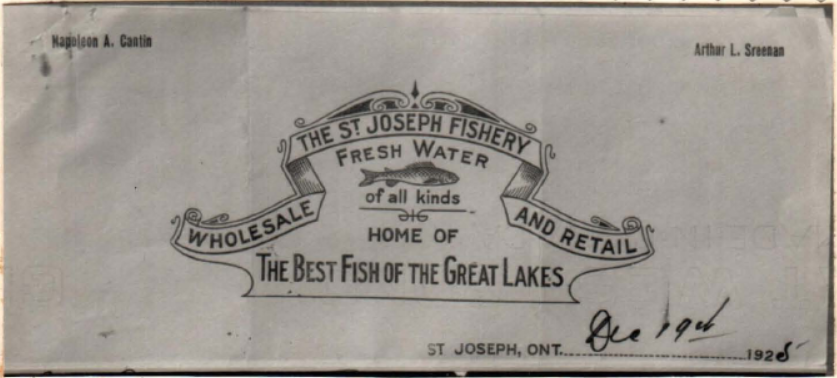
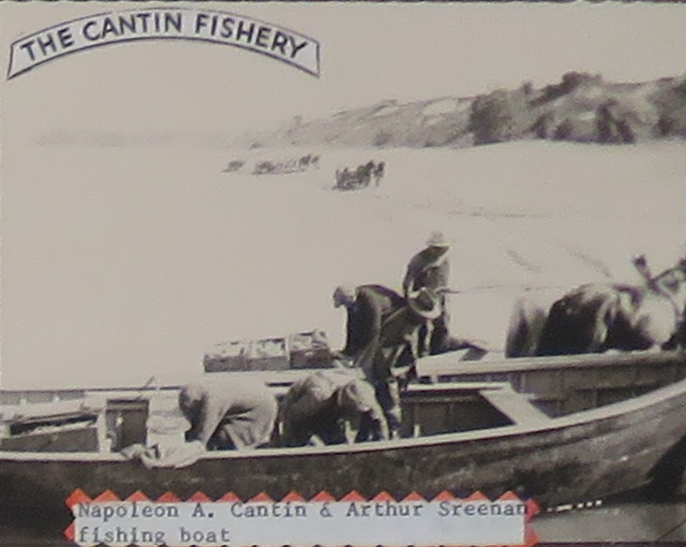
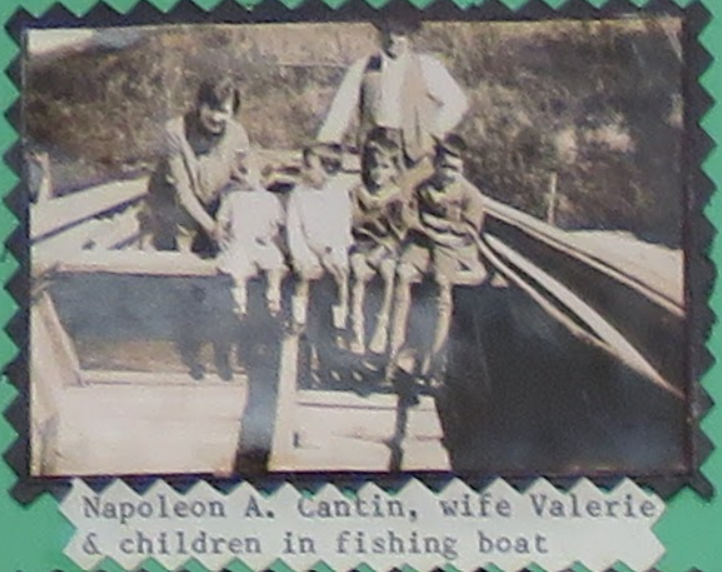
The fishery was sold to Napoleon A. Cantin and Arthur L. Sreenan in 1919 and operated under the “St. Joseph Fishery”. It included all pound nets, boat, scow, fish house, ice house, and all other material as well as the Brisson rights to the fishing grounds in Lake Huron.
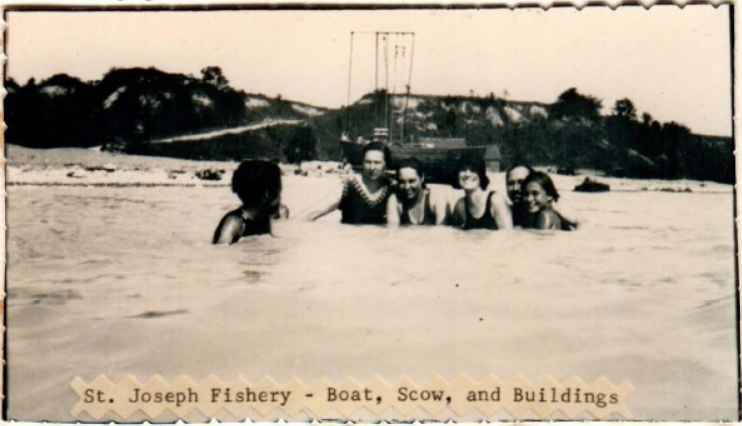
The Fishery soon became a successful commercial enterprise as fishing was plentiful. The pound nets were lifted daily or every second day. depending on the weather. Many families from the surrounding area came to buy their fish at the fish shanty at the beach. Also, in those days there were many fish peddlers going from home to home. However, most of the fish was packed in ice, in fish boxes, and picked up daily by truck from different fish companies from Chicago and New York.
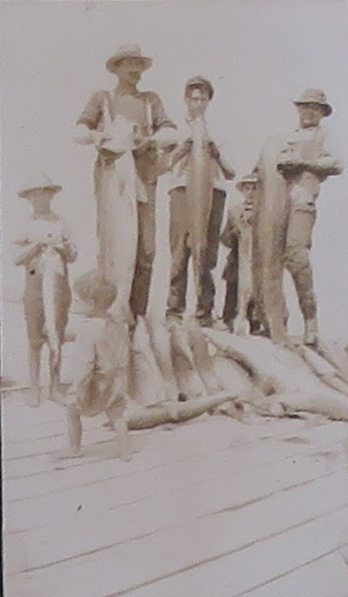
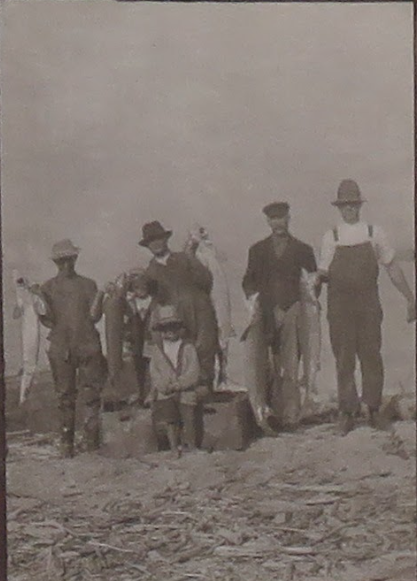
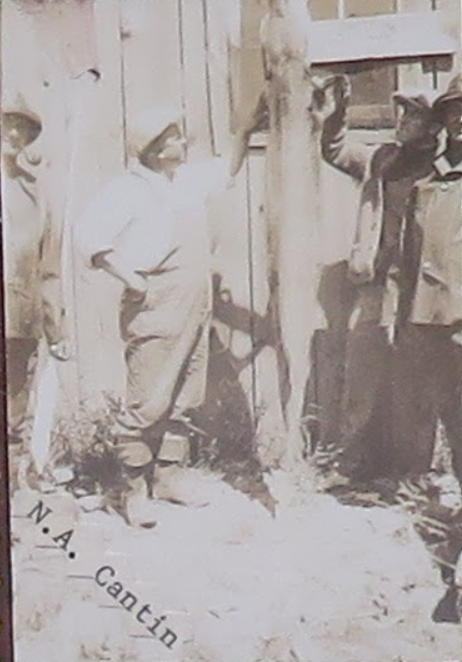
In those days fish was plentiful with a large variety to choose from i.e. herring, perch, pickerel, white fish, trout, catfish and sturgeon. Sturgeons were plentiful and very large.
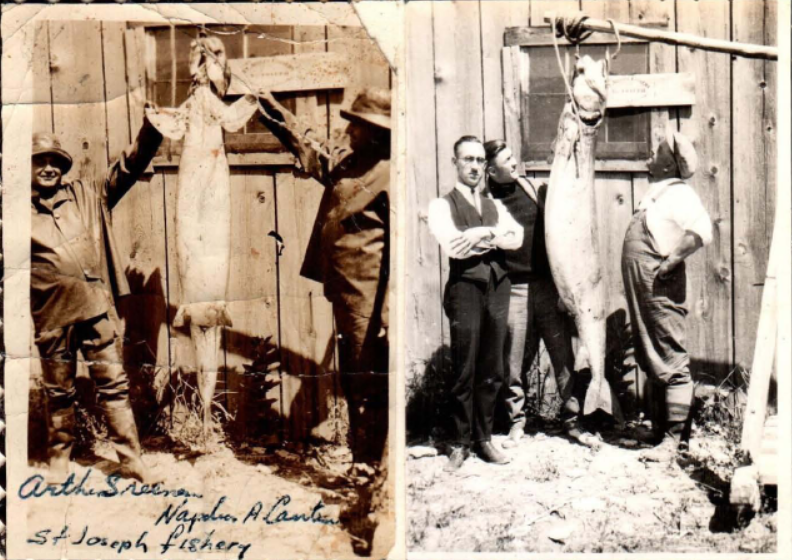
The female sturgeon were especially valuable due to their eggs used for caviar, making it a real delicacy. The female sturgeon were cut open and the eggs carefully removed, then packed separately in ice for immediate shipment.
In the years 1929 and 1930 pound net fishing was becoming an expensive operation, The fishing ground restrictions placed by the Ministry of Fisheries prevented the choosing of choice fishing locations by the owner. It became more and more difficult to find the quality pound net stakes that could withstand the pounding pressure needed to install. Due to the frequent ferocious storms the nets were often damaged and had to be raised and repaired. All this added to continued increasing expense making living conditions as a fisherman almost impossible. Imagine trying to make a living selling fish at 5¢ a pound.
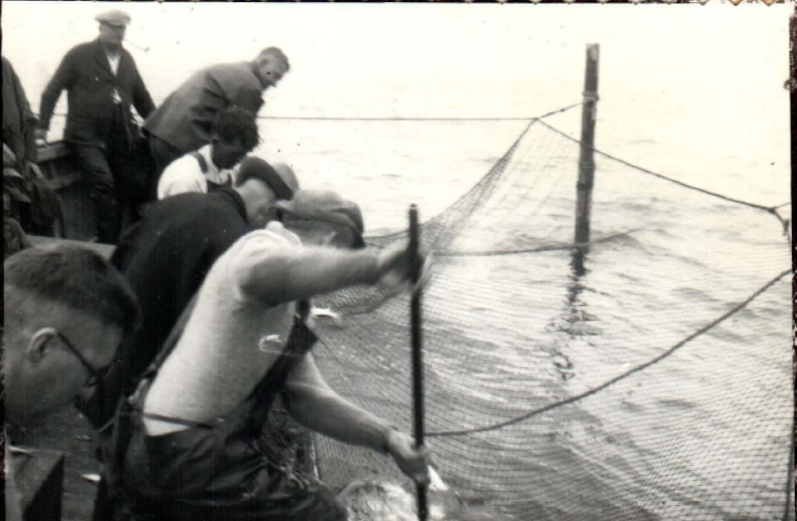
In 1930 Napoleon applied for a Trap Net license from the Department of Games and Fisheries but it was refused after several requests. The Department indicated the difficulty there would be in controlling the legitimate operations of this type of net that could be submerged at any depth and the location would be difficult to determine. They stated that it would be a great mistake to introduce this type of net in our provincial waters.
On January 11, 1932 Napoleon wrote a letter to the Honorable Charles McCrea, Minister of Games and Fisheries, regarding the Department’s refusal to grant his request, even though trap nets were extensively used on the American side of the International Line. Napoleon found it difficult to understand why Canadians, dependent for their living on the success of their fishing, should not be granted the same concessions as were granted to the America fisherman in the same waters. He stated that after all a trap net was a pound net. The first is moveable while the second is set and immovable. He further stated that the conditions which apply to the granting of pound net licenses could easily and quite properly be made applicable to the granting of trap net licenses, etc.
On January 19, 1932 the Honorable Charles McCrea approved Napoleon’s request for a Trap Net License using the term “a moveable Pound Net” with the understanding that three buoys be used – one at each end of the lead and one at the pot with Napoleon’s name legibly marked on each buoy. This approval made it the first license ever to allow Trap Net fishing in Canada.
In 1932 a reorganization of the St. Joseph Fishery was established with the understanding that Arthur Sreenan and his son Gerald would operate the pound nets and Napoleon , with a new partner W.J. (Jack) Johnston would operate the trap nets. It was then necessary to establish for the Department what fishing grounds would be allotted for the fixed pound nets and for the moveable pound nets. The agreement between the two fisheries was a very amicable arrangement where they continued this good working relationship by helping each other.
The moveable pound nets (trap nets) required deep water, 25 to 48 feet, and for that depth it was necessary to set these nets at least five miles out from shore to reach the proper depth. A new thirty foot flat bottom boat with a high prow to ride the waves was built.
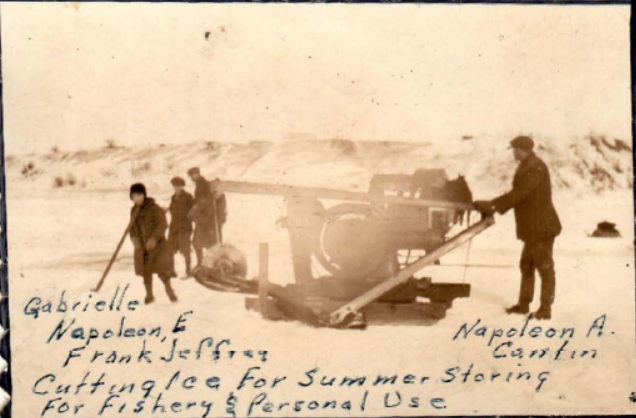
Every year during February or March when the ice on the lake was at least twelve inches thick it was cut in blocks with a gas-engine power saw on sleigh-type runners. Then the ice was carried by horses and bob sleighs to the ice houses and packed with saw dust for the fisheries and for summer use.
The St. Joseph Fisheries also accomplished some outstanding rescue missions during their many years in operation. Some of these include:
The government dredge P.W.D. Barge No. 53 also sank in Lake Huron in eighty-two feet of water off Bayfield on June 23, 1932. The dredge was pulling the scow on its way to the Goderich harbor. There were two steel gravel scows and a wooden coal carrier. Knowing that the dredge was in trouble, Goderich sent a tug boat to see how the dredge was holding out in the storm. They found that the dredge was sinking and one of the lines had broken and two of the scows were drifting away. They pulled the other steel scow to the Goderich harbor while the other two scows were left drifting away towards St. Joseph. Napoleon Cantin and Arthur Sreenan immediately took their boat out and fortunately managed to anchor the steel scow while the wood scow had landed between William Ducharme’s beach at St. Joseph and was cracked open.
The steel scow was saved and the coal scow was completely destroyed. However, most of the equipment was rescued by Napoleon and Arthur and returned to the government. A bill was submitted to the Department of Public Works of Canada, Dredging Department, July 7th, 1932, by Napoleon and Arthur, in the amount of $142.00. “For labor and gasoline for the boat and for damage done to one of their trap nets by the P.W.D. Barge No. 53, the cost for pulling the nets, repairing and resetting the nets.” All this for saving the steel gravel scow and tools for the government, all for only $142.00. Registered cheque received July 17th, 1932, from D.P.W., Ottawa, payable to the St. Joseph Fisheries.
St. Joseph fishermen were also part of the large group of searchers when Babe Siebert drowned in Lake Huron August 25, 1939 at St. Joseph. Despite the strenuous efforts made, it was a couple of days before the body was found. Babe was attending a family reunion to mark his father’s birthday in Zurich when he decided to go swimming and his daughters, Judy, 11, and Joan, 10. One of the girls had been playing with an inflatable rubber tube and was carried out with the breeze. Babe went after it and unfortunately he was stricken with a cramp and drowned almost immediately. Babe Siebert had just been appointed as coach of the Montreal Canadiens. He was only 35 years old. He was voted to the Hockey Hall of Fame just 25 years after his untimely death. Another dangerous encounter happened when a man decided to swim to the first pound net stake at St. Joseph. He never realized how far it was until he got to the stake. He then got panicky and could not swim back. He held onto the stake and called for Napoleon to come and get him. It wasn’t too long before Napoleon got his boat out and arrived in time to save him. He was a very happy and grateful person.